
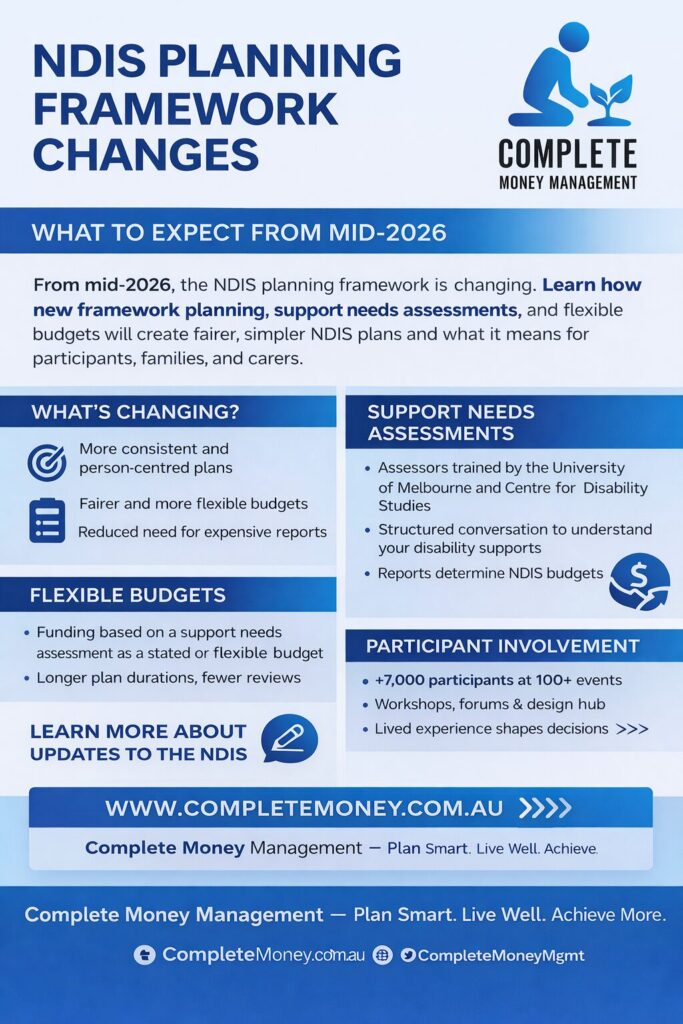
New NDIS Planning Framework Explained: What’s Changing From Mid-2026 and What It Means for Participants
From mid-2026, the way the National Disability Insurance Scheme (NDIS) creates plans will begin to change. These reforms are designed to make NDIS planning fairer, more consistent, and easier to navigate for participants, families, carers, and providers.
This new approach is known as new framework planning, and it represents one of the most significant changes to NDIS planning since the Scheme began.
In this guide, we break down what’s changing, why it matters, how budgets will work, and what participants can expect next.
Why Is NDIS Planning Changing?
Thousands of people with disability, families, carers and service providers told the Independent Review of the NDIS that the current planning system needed improvement. Common concerns included:
Inconsistent budgets
Over-reliance on expensive reports
Plans that were too rigid
A lack of transparency in decision-making
In response, the Australian Government updated the NDIS Act in October 2024, enabling a new, more consistent planning approach focused on disability support needs, rather than functional impairment alone.
The NDIA and the Department of Health, Disability and Ageing have been working closely with state and territory governments and the disability sector to design these changes.
👉 You can read official information about the reforms on the Department’s website:
New framework planning – Department of Health, Disability and Ageing
When Will the New NDIS Planning Framework Start?
The new planning framework is expected to begin rolling out from mid-2026.
Importantly:
The rollout will be phased, not immediate
Many participants won’t notice changes straight away
Existing plans will continue as usual until transitioned
Public consultation on the new framework planning rules is expected to begin in early 2026, giving the community an opportunity to provide feedback before full implementation.
What Is New Framework Planning?
New framework planning introduces a person-centred, strengths-based approach to building NDIS plans.
Instead of focusing heavily on diagnoses or functional impairment scores, the new system will look at:
How you live your life
What supports you need day-to-day
What helps you achieve your goals
The role of family, carers and community
Key Benefits of the New Approach
New framework planning is designed to:
Create fairer and more consistent budgets
Reduce the need for costly specialist reports
Deliver simpler, more flexible plans
Give participants greater certainty with longer plan durations
What Is a Support Needs Assessment?
A major change under the new framework is the introduction of a support needs assessment.
This assessment:
Is completed by a trained, accredited assessor
Takes place at a time and location suitable for the participant
Allows participants to bring family, carers or support people
How the Assessment Works
The assessor will have a structured conversation with the participant about their daily life, environment, and disability-related support needs.
After the assessment:
A support needs assessment report is prepared
The report informs how a participant’s NDIS budget is built
Final plans are still approved by trained NDIA staff, not automated systems
Under the new framework, NDIA staff will spend more time with participants than they do under the current planning model.
Who Conducts Support Needs Assessments?
Assessments will be completed by assessors who:
Undertake a specialised training and accreditation program
Are trained using programs developed with the University of Melbourne and the Centre for Disability Studies
New NDIS rules currently being developed will formally outline how assessments are conducted and applied.
What Is the I-CAN v6?
The new planning framework will be based on the Instrument for the Classification and Assessment of Support Needs (I-CAN v6).
The I-CAN v6:
Is a person-centred, strengths-based tool
Identifies disability-related support needs
Has been used in the care sector for over 20 years
Was developed by the Centre for Disability Studies
It will be used alongside a personal and environmental circumstances questionnaire to capture information about housing, relationships, community access, and other real-world factors.
Some participants with more complex needs may still be asked to provide reports from treating health professionals.
How Will NDIS Budgets Change?
Under new framework planning, budgets will be determined by applying information from the support needs assessment using a consistent method set out in the rules.
Key Budget Changes
Budgets will be more flexible, rather than tied to individual line items
Funding may be provided as:
Stated supports (must be used for a specific purpose), or
A flexible budget for general NDIS supports
Plans will generally cover longer periods, reducing the need for frequent reviews
This means participants can spend less time re-planning and more time using their supports.
👉 Learn how plan budgets are managed in practice:
NDIS Plan Management Services – Complete Money Management
Will Review Rights Still Apply?
Yes. Participants will retain all existing review rights.
You can still:
Request a reassessment or plan variation if your circumstances change
Request an internal review of a planning decision
Apply for an external review through the Administrative Review Tribunal (ART) if needed
These rights are unchanged under the new framework.
How Is the Disability Community Involved?
People with disability are playing a central role in shaping the new planning system.
Over the past year:
More than 7,000 participants, families, providers and stakeholders
Have taken part in over 100 consultation activities
This includes:
Workshops and forums
Co-design and advisory groups
Testing through the New Framework Planning Pool and Design Hub
This engagement ensures lived experience remains central to NDIS reform.
Learn More About the NDIS Changes
The NDIA is running information sessions called:
“Understanding the NDIS: Overview of Changes for Participants, Families and Carers”
👉 View session details and register here:
Understanding the NDIS Sessions
For broader context on reforms, visit:
Improving the NDIS
Final Thoughts: What This Means for Participants
New framework planning represents a significant shift toward fairness, transparency and consistency in the NDIS.
While changes won’t happen overnight, the long-term goal is clear:
Plans that better reflect real support needs
Less administrative burden
Greater flexibility and certainty for participants
If you’d like help understanding how these changes may affect your funding, plan structure, or future reviews, Complete Money Management can guide you through the transition with confidence.