
NDIS Changes 2026: What the New NDIS Legislation Means for Participants and Providers
Updated: 29 August 2026
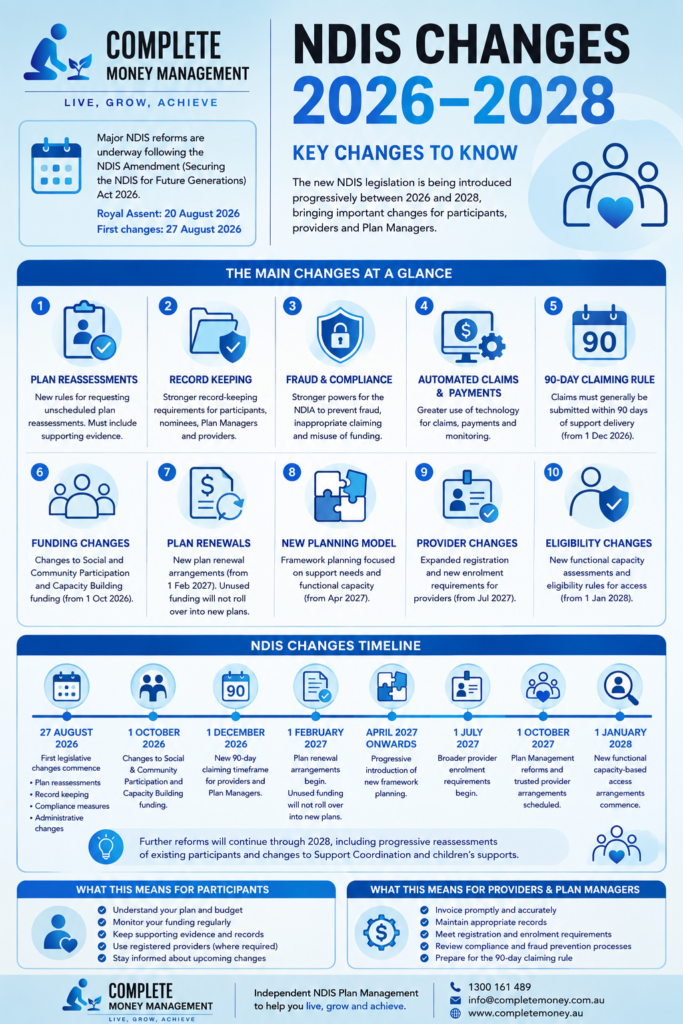
Major NDIS changes in 2026 have now begun following the passage of new legislation designed to reform the National Disability Insurance Scheme.
The National Disability Insurance Scheme Amendment (Securing the NDIS for Future Generations) Act 2026 received Royal Assent on 20 August 2026, with the first major changes commencing on 27 August 2026.
However, not all of the changes start at once.
The reforms will be introduced progressively through 2026, 2027 and 2028 and will affect NDIS participants, families, nominees, Plan Managers, Support Coordinators and providers.
If you’re unsure how your existing funding works, our guide to understanding your NDIS plan is a useful place to start.
This guide explains the new NDIS legislation, what has already changed, what’s coming next and what participants and providers need to know.
What Are the New NDIS Changes in 2026?
The NDIS changes in 2026 introduce new rules covering plan reassessments, record keeping, fraud and compliance, NDIS claims, participant funding, provider registration and Plan Management.
The first changes commenced on 27 August 2026, with further reforms scheduled progressively through 2027 and 2028.
Key NDIS changes include:
- New requirements for requesting plan reassessments
- Stronger NDIS record-keeping requirements
- Greater fraud and compliance powers
- Increased automated claim and payment processing
- A new 90-day claiming timeframe
- Changes to Social and Community Participation funding
- New NDIS plan renewal arrangements
- New framework planning
- Expanded provider registration and enrolment
- Major changes to NDIS Plan Management
- New functional capacity assessments for NDIS access
- Changes to Support Coordination
Participants and providers can also follow the official Australian Government NDIS legislation changes for future updates.
What NDIS Changes Started on 27 August 2026?
Several important provisions of the new legislation commenced on 27 August 2026.
These include changes to plan reassessments, record keeping, compliance and administrative processes.
Changes to NDIS Plan Reassessments
One of the first changes affects how participants can request an unscheduled reassessment of their NDIS plan.
From 27 August 2026, only:
- The participant
- Their nominee
- Their child representative
can request a plan reassessment.
A reassessment request needs to explain what has changed and why a reassessment is required.
Participants must also provide supporting evidence, which may include evidence from a GP or other health professional.
Once the NDIA has the information it requires, it will generally make a decision within 90 days.
The NDIA may decide to:
- Reassess the participant’s plan
- Refuse the reassessment
- Vary the existing plan
Participants can read the official NDIS plan reassessment requirements.
You can also read our guide to understanding your NDIS plan for more information about how NDIS plans and funding work.
New NDIS Record-Keeping Requirements
The legislation introduces stronger requirements around records relating to NDIS supports and payments.
Depending on the circumstances, participants, nominees, Plan Managers and providers will need to retain relevant records for specified periods.
For providers, records relating to the payment and receipt of NDIS funds may need to be retained for 7 years.
This makes accurate record keeping increasingly important.
Records may include:
- Provider invoices
- Evidence that supports were delivered
- Service agreements
- Payment records
- Claim information
- Supporting documentation
- Communications relating to disputed invoices
- Participant approvals where relevant
For NDIS Plan Managers, maintaining a comprehensive and secure audit trail will become increasingly important as the NDIA increases its focus on payment integrity.
Stronger NDIS Fraud and Compliance Powers
Fraud prevention is one of the central elements of the Government’s NDIS reform program.
The Government has identified four major reform priorities:
- Fighting fraud and stopping inappropriate claiming
- Slowing rapid NDIS cost growth
- Creating clearer eligibility requirements
- Improving the quality of services delivered to participants
The new legislation strengthens the NDIA’s ability to monitor payments, obtain information and investigate potential misuse of NDIS funding.
For legitimate participants and providers, this makes accurate documentation more important than ever.
Providers should ensure invoices accurately reflect:
- The support delivered
- The date of service
- The participant receiving the support
- The amount charged
- The relevant NDIS support
- Any other information required to substantiate the claim
Automated NDIS Claims and Payments
The NDIS is also moving toward a more automated and data-driven payment system.
Computer systems may increasingly be used to undertake specified administrative processes associated with claims and payments.
This could allow the NDIA to identify unusual claiming patterns more efficiently.
For participants, providers and Plan Managers, the message is increasingly clear:
Accurate invoices, supporting evidence and good record keeping will become essential parts of the NDIS payment system.
NDIS Funding Changes From 1 October 2026
Another significant group of changes begins from 1 October 2026.
These reforms affect funding associated with areas including:
- Social, economic and community participation
- Improved Daily Living Skills / Capacity Building activities
The changes are intended to address differences in funding levels between participants with similar support needs.
Participants should pay particular attention to these changes when receiving a new or reassessed plan.
If your plan contains Capacity Building funding, read our detailed guide to NDIS Capacity Building Supports.
$200 Million Inclusive Communities Fund
The Government has also announced a $200 million Inclusive Communities Fund.
The intention is to expand opportunities for people with disability to participate in mainstream and community activities outside individually funded NDIS supports.
This forms part of a broader shift toward providing some disability supports through community and mainstream systems alongside the NDIS.
90-Day NDIS Claiming Rule From 1 December 2026
One of the most important practical changes for providers and Plan Managers begins on 1 December 2026.
What Is the New NDIS 90-Day Claiming Rule?
Participants or their Plan Managers will generally need to submit NDIS claims within 90 days of the support being delivered.
This is a major reduction from the previous claiming timeframe.
What Does This Mean for NDIS Providers?
Providers should:
- Submit invoices promptly
- Avoid allowing invoices to accumulate
- Ensure invoices contain accurate information
- Correct rejected invoices quickly
- Maintain appropriate service records
- Monitor outstanding accounts
- Respond promptly to Plan Manager invoice queries
Waiting several months before sending invoices could create significant payment problems once the new timeframe applies.
What Does This Mean for Plan Managers?
Plan Managers should consider implementing:
- Invoice-age monitoring
- Automated warnings for older invoices
- Clear provider communication
- Invoice validation processes
- Processes for rejected or incomplete invoices
- Comprehensive audit trails
The 90-day claiming requirement makes efficient invoice processing even more important.
NDIS Plan Changes From 1 February 2027
Another significant stage of the reforms begins on 1 February 2027.
New NDIS Plan Renewals
When a participant’s plan reaches its reassessment date, the NDIA may create a renewed plan.
Where appropriate, the renewed plan may maintain funding at the level for which the participant has been assessed, adjusted for current prices.
This may reduce the need to completely rebuild plans for participants whose support needs have remained stable.
What Happens to Unused NDIS Funding?
Under the new plan renewal arrangements, unspent funding from the previous plan will not roll over into the renewed plan.
This is an important change.
However, participants should never spend NDIS funding simply because a plan is approaching its end date.
NDIS funding must still be used for appropriate disability-related supports in accordance with the participant’s plan and applicable NDIS funding rules.
Good budget monitoring will therefore become increasingly important.
Changes to Reasonable and Necessary Supports
The reforms also change how the NDIA determines what supports are considered reasonable and necessary.
The intention is to create greater consistency between participants with similar circumstances and support needs.
For children, there will also be clearer guidance around what support a parent would ordinarily be expected to provide.
This may include consideration of:
- Supervision
- Personal care
- Transport
- Emotional support
- Behavioural support
The important distinction will be between ordinary parental responsibility and additional support required because of the child’s disability.
New NDIS Planning System From April 2027
One of the biggest structural reforms is the introduction of a new approach to NDIS planning.
The Government describes this as new framework planning.
What Is NDIS Framework Planning?
Instead of determining a participant’s budget primarily by examining individual requested supports, the new system will place greater emphasis on assessing the participant’s overall support needs.
A support needs assessment may consider:
- The types of support required
- Frequency of support
- Amount of assistance required
- Functional capacity
- Level of disability-related need
- Relationship between the support and eligible impairment
The assessment will then contribute to determining the participant’s NDIS budget.
More Flexible NDIS Budgets
The new planning model is intended to provide participants with greater flexibility across parts of their overall budget.
Some supports may still be specifically stated or restricted.
The practical effect will depend heavily on the final NDIS Rules, assessment tools and budget methodology.
Participants should continue following the rules applying to their existing plans until advised that the new planning arrangements apply to them.
NDIS Provider Registration and Enrolment Changes
The Government is also significantly changing how providers operate within the NDIS.
Mandatory registration is being expanded progressively, particularly for higher-risk supports.
Examples identified by the Government include:
- Personal care
- Daily living supports
- Supports provided in closed settings
The Government is also introducing broader provider enrolment.
Most providers that receive NDIS payments are expected eventually to provide identifying and business information to the NDIA, giving the Agency greater visibility over who is receiving NDIS funding.
Providers should continue checking current requirements through the NDIS Quality and Safeguards Commission.
Major NDIS Plan Manager Changes From October 2027
For participants who choose to have their funding plan-managed, one of the most significant reforms relates directly to the Plan Management industry.
What Is the Trusted Plan Manager Panel?
The Government intends to introduce a trusted panel of Plan Management providers.
This represents a significant change to the existing Plan Management market.
Rather than registration alone determining which businesses can operate as Plan Managers, providers may need to satisfy additional requirements to participate in the new arrangements.
The detailed selection criteria and implementation requirements will be particularly important for existing Plan Management providers.
Likely areas of increased scrutiny include:
- Financial governance
- Fraud prevention
- Invoice verification
- Participant safeguards
- Cybersecurity
- Complaints management
- Conflict-of-interest management
- Record keeping
- Compliance history
- Service quality
- Financial controls
- Data and reporting capability
Participants currently using the PACE system can also read our guide explaining how to endorse your NDIS providers.
Are NDIS Plan Managers Being Removed?
No. NDIS Plan Management is not being abolished.
However, the Government is making significant changes to how Plan Management providers will operate.
The proposed trusted-provider arrangements are intended to improve:
- Quality
- Financial integrity
- Participant safeguards
- Fraud prevention
- Oversight of NDIS payments
Participants using Plan Management should continue using their existing arrangements unless advised otherwise by the NDIA.
New NDIS Eligibility Rules From 1 January 2028
Another major reform begins from 1 January 2028.
The NDIS will move toward a more standardised approach to determining whether a person’s disability substantially reduces their functional capacity.
What Is an NDIS Functional Capacity Assessment?
A functional capacity assessment examines how a person’s impairment affects their ability to undertake everyday activities.
Areas considered may include:
- Mobility
- Communication
- Social interaction
- Learning
- Self-care
- Self-management
Under the reforms, access to the NDIS will increasingly be based on a standardised, evidence-based assessment of functional capacity.
Is the NDIS Moving Away From Diagnosis-Based Access?
Yes, to an extent.
The reforms place substantially greater emphasis on functional impact rather than relying principally on a particular diagnosis.
This means having a particular diagnosis will not necessarily determine whether someone qualifies for the NDIS.
Instead, the assessment will consider how significantly the person’s permanent impairment affects their everyday functional capacity.
Changes to the NDIS Permanence Test
The reforms also strengthen the consideration of whether an impairment is permanent or likely to be permanent.
For new applicants from 2028, the NDIA may consider:
- Whether appropriate treatment has occurred
- Whether other treatment is likely to substantially improve the impairment
- Whether the impairment is permanent or likely to be lifelong
This makes good medical and functional evidence increasingly important when applying for NDIS access.
What Happens to Existing NDIS Participants?
Existing participants will not all suddenly be reassessed on 1 January 2028.
The Government intends to progressively reassess existing participants under the new arrangements over approximately three years.
There are also specific transitional arrangements affecting some groups.
Participants should therefore rely on information provided by the NDIA about when the new arrangements apply to them.
For the latest official information, visit the NDIS Changes hub.
Changes Affecting Children With Developmental Delay and Autism
The Government has also announced significant changes affecting children aged 8 and under with developmental delay and/or autism.
Under the proposed future arrangements, children with low to moderate support needs are intended to receive support through the Thriving Kids system rather than the NDIS.
Children with permanent and significant disability or substantially reduced functional capacity and high support needs may remain eligible for the NDIS.
These arrangements are still being developed with states and territories, so families should monitor future Government announcements carefully.
NDIS Support Coordination Changes
Support Coordination is also expected to change under the broader NDIS reform program.
The Government intends to move toward new commissioned support coordination and connection functions.
This could substantially change how Support Coordination is funded and delivered.
Further implementation details will be required before the full impact on existing Support Coordinators and participants is known.
NDIS Changes 2026–2028 Timeline
| Date | Key NDIS Change |
|---|---|
| 27 August 2026 | First new legislative changes commence, including plan reassessment and compliance measures |
| 1 October 2026 | Changes affecting specified Social and Community Participation and Capacity Building funding |
| 1 December 2026 | New 90-day claiming timeframe |
| 1 February 2027 | Plan renewal and unused funding rollover changes |
| 2027 | Progressive introduction and development of new framework planning |
| 1 July 2027 | Broader provider enrolment changes begin |
| 1 October 2027 | Plan Management reforms/trusted panel arrangements scheduled |
| 1 January 2028 | New functional capacity-based access arrangements commence |
| 2028 | Progressive implementation of further planning and support reforms |
What Do the NDIS Changes Mean for Participants?
The new legislation makes understanding your NDIS plan increasingly important.
Participants should:
- Understand their NDIS budget
- Monitor funding regularly
- Keep appropriate records
- Maintain supporting evidence
- Ensure providers invoice promptly
- Review plan reassessment requirements
- Understand applicable funding periods
- Check whether providers need to be registered
- Monitor future eligibility and planning changes
If you’re unsure where to start, read our guide to understanding your NDIS plan.
What Do the NDIS Changes Mean for Providers?
Providers should prepare for greater scrutiny of NDIS claims and transactions.
Good practice includes:
- Issuing invoices promptly
- Maintaining accurate service records
- Keeping required documentation
- Reviewing registration and enrolment requirements
- Maintaining appropriate service agreements
- Ensuring claims accurately represent services delivered
- Strengthening fraud and compliance controls
- Preparing for greater digital verification
The 90-day claiming rule should be a particular operational priority before December 2026.
What Do the Changes Mean for Plan-Managed Participants?
Plan Management continues to provide participants with assistance managing the financial administration of their NDIS funding.
A Plan Manager can help with:
- Processing provider invoices
- Monitoring NDIS budgets
- Providing financial reports
- Tracking available funding
- Identifying potential overspending
- Maintaining financial records
- Working with providers
- Working alongside Support Coordinators
- Helping participants understand their expenditure
The proposed Plan Management reforms make choosing a Plan Manager with strong financial controls, compliance systems and participant service increasingly important.
Frequently Asked Questions About the NDIS Changes
What are the new NDIS changes in 2026?
The new NDIS legislation introduces changes covering plan reassessments, record keeping, compliance, claiming, participant funding, planning, provider registration, Plan Management, eligibility and Support Coordination. The reforms are being introduced progressively between 2026 and 2028.
When did the new NDIS legislation start?
The National Disability Insurance Scheme Amendment (Securing the NDIS for Future Generations) Act 2026 received Royal Assent on 20 August 2026. The first major changes commenced on 27 August 2026.
What changed with NDIS plan reassessments?
From 27 August 2026, only a participant, their nominee or child representative can request a plan reassessment. The request needs to explain what has changed and include supporting evidence. Once the NDIA has the information it requires, it generally has 90 days to make a decision.
Is there a 90-day limit for NDIS claims?
Yes. From 1 December 2026, participants or their Plan Managers will generally need to make claims within 90 days of service delivery.
Are NDIS Plan Managers being removed?
No. NDIS Plan Management is not being abolished. However, significant reforms are being introduced to how Plan Management providers operate, including trusted-provider arrangements.
Are NDIS eligibility requirements changing?
Yes. From 2028, NDIS access will place greater emphasis on standardised assessment of functional capacity and the impact of permanent impairment on everyday life.
Does having an autism diagnosis automatically qualify someone for the NDIS?
No. A diagnosis alone does not automatically establish NDIS eligibility. Eligibility depends on the legislative access criteria, including the permanence and functional impact of an impairment.
Will unused NDIS funding roll over?
Under the new plan renewal arrangements commencing from February 2027, unspent funding from the previous plan will not roll over into the renewed plan. Different rules may apply to plans operating under existing arrangements before these provisions commence.
Will all NDIS providers have to register?
Provider registration is being progressively expanded for identified higher-risk supports. Broader provider enrolment requirements are also being introduced to improve NDIA oversight of providers receiving NDIS payments.
Need Help Understanding Your NDIS Funding?
The NDIS is undergoing some of the most significant changes since the Scheme was established.
Understanding your funding, invoices and available budgets is becoming more important than ever.
Complete Money Management provides NDIS Plan Management to help participants:
- Process provider invoices
- Monitor their NDIS budgets
- Track available funding
- Receive regular financial reporting
- Work with providers and Support Coordinators
- Better understand how their funding is being used
Contact Complete Money Management today to learn more about NDIS Plan Management and how we can help you manage your NDIS funding.
👉 Contact Complete Money Management